







![CALCULATING THE CHANGES. As study habits have changed, the materials used have changed too. "I remember the day when [my brother] came home with his graphing calculator, [which] had Mario. And I was blown away," Spanish teacher Peter Daniels said. (Photos: Fair Use; Wikimedia Commons)](https://www.rubiconline.com/wp-content/uploads/2026/05/Untitled-design-4-1200x800.png)

























![BEWARE. Junior Maisy Torres was expecting a Nickelodeon ride when she entered the haunted house at the State Fair. What she encountered was much more horrifying. "There's not enough money in the world to pay me to do [it again]," Torres said.](https://www.rubiconline.com/wp-content/uploads/2026/05/Never-again-with-nabeeha-1-e1778077989386-1200x802.png)


![[QUIZ] What famous scientist are you?](https://www.rubiconline.com/wp-content/uploads/2026/01/Untitled-design-3.gif)







In February 2024, over 60 teachers from independent schools in the Twin Cities, such as Mounds Park Academy and Blake, met together to talk about AI use in classrooms and their impact. These discussions have led to the update in SPA’s own AI use policy.
Originally, the policy was a complete ban on generative AI use because it was seen as a detrimental product in the classroom environment. With advancements in AI tools, students and teachers need to make the boundaries of AI use clearer.
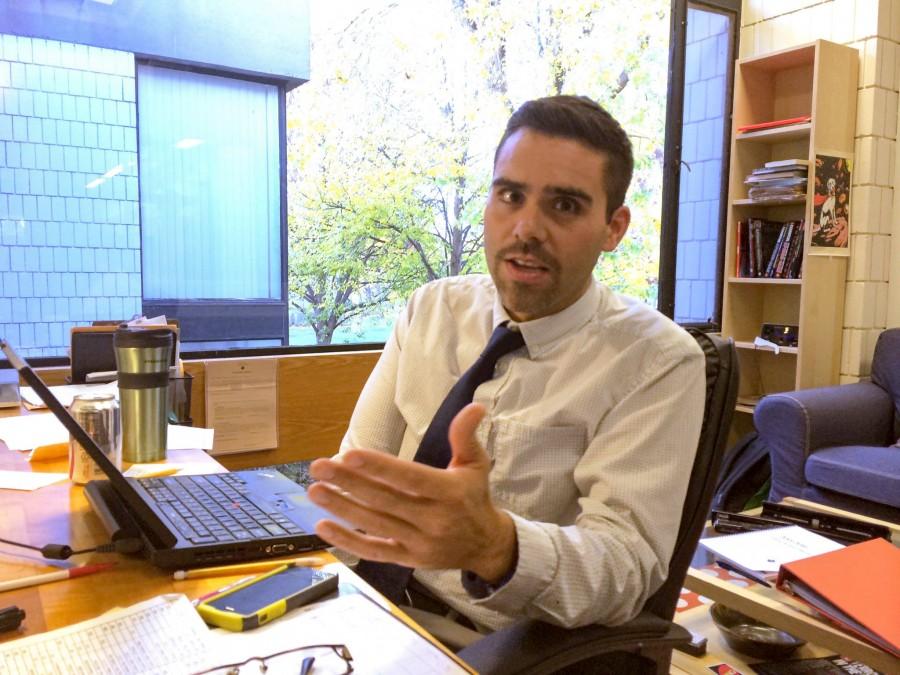
Zach Sheffert, a teacher for math and data science, spearheaded the new classroom policy as he has found that AI has many encouraging and productive uses that potentially outweigh the risks. He recognizes students’ widespread use and has begun thinking of ways to use it creatively to accelerate learning. There are many destructive uses of it, but understanding that AI has expanded to pretty much every industry, and the need to jump on the train to better prepare students for the future, is what he has been working towards. “This [new policy] was an attempt to give people a more flexible way that they could use AI […] I think that improper use is clearly going to erode a lot of the skills we are trying to teach, but there are other techniques that these generative AI tools would be good for.” Sheffert said.
Sheffert experimented with AI during his research. He believes the best way to understand if the tools are useful is to use them yourself and find the boundaries of what the tools are good at. Advancements in AI have inspired Sheffert to investigate many large language models (LLM) such as Gemini, Claude, Deepseek, and ChatGPT. Each of these LLM’s have its own strengths, and specifically for Sheffert, he has been leaning towards Gemini to help generate practice problems. “ChatGPT has been legendarily bad at hallucinating mathematics, and I think that Gemini has a better trigger for ‘I need precision here’ so Gemini has definitely been the most productive for me.” Sheffert said.
In the future, Sheffert says teachers will meet with each other and evolve the terms of the AI policy further.
Senior Ryan Shiroma expressed similar beliefs in the benefits of AI use. “I think it’s a double-edged sword. In some of my classes, teachers have used AI to demonstrate something cool, but then, it’s a lot easier to do some stuff that shouldn’t be going on with AI.” Shiroma said. When asked about detrimental uses of AI in class, he said, “That’s news to me.”
Sophomore Pete Hovan, a representative for the Student Technology Committee (STC) discussed evolving AI use policy in other schools. While noting AI’s growing importance, he noted it can also hinder learning if students rely on it excessively. The AI policy should focus on balancing its use with traditional learning methods. “I feel that it can be really detrimental to a student’s brain and ability to think and learn,” Hovan said.
The student and teacher body have differing views on the usage of AI; however, both sides recognize its importance as it has expanded to many various industries. The policy is on track to expand and improve its balance between its benefits and harms in classrooms. In general, most students recognize the improvement in class productivity this year versus last year.
(Image and caption updated on 9/2/2025)
![DYNAMIC DISCUSSION. Students gather around a Harkness table to discuss George Orwell’s 1949 novel “1984.” Assembled by English teachers Jessica Gokhberg and Julia Callander, the book club is open to all students and meets weekly. “[Orwell is] a pretty accessible writer. He’s pretty engaging,” Callander said.](https://www.rubiconline.com/wp-content/uploads/2026/03/DSC_2772-1200x800.jpg)


![[The 5] tensions rise globally and locally: deadly strikes in Gaza, tragedy in Minnesota, and chaos on U.S. roads](https://www.rubiconline.com/wp-content/uploads/2025/04/The-5-2.jpg)