How comedians became unexpected guardians of democracy


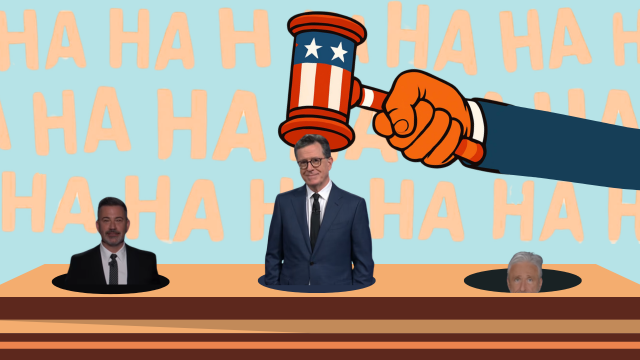
Comedy has long served as one of America’s most accessible checks on political power – a place where humor becomes a form of accountability. However, during President Donald Trump’s second term, tensions between political satire and political authority have sharpened, raising questions about how far comedians can go before facing consequences.
That debate erupted on Nov. 17, 2026, when ABC and its parent company, Disney, temporarily pulled “Jimmy Kimmel Live!” off the air. That decision followed Kimmel’s remarks about conservative activist Charlie Kirk after his assassination, comments that drew intense backlash from conservative audiences. According to network sources, executives urged Kimmel to soften his planned monologue addressing the controversy. When he refused, Disney CEO Bob Iger approved the suspension.
Kimmel eventually returned to the air, but the incident has become a flashpoint in a broader pattern of political pressure on media, particularly when the target of the joke is the government itself.
Students see comedy as a constitutional issue
For many young people, the Kimmel suspension represents more than a programming dispute. Junior Gavin Leuthold, a strong supporter of constitutional rights, sees it as a direct challenge to the First Amendment. “I think it’s really unfortunate that his comedy is being censored by the government because I think … freedom of speech should be protected for comedians to make jokes about the government,” Leuthold said. “[Also] I think that censorship of Jimmy Kimmel just goes against the First Amendment.”
Junior Mattias Halloran, who follows most of his comedy through social media and “Saturday Night Live,” believes comedians play a unique civic role. I think comedians, especially those who critique officials, can serve as a more lighthearted check on the powers of the government,” Halloran said. “For example, if the government says it is going to do something and underwhelmingly delivers on the promise, comedians can showcase that to the public in a format a little easier to digest than reading bland news articles.”
A long history of satire vs. power
The tension between humor and authority is not new in the United States. One of the earliest landmark cases for press freedom dates back to 1735, when New York printer John Peter Zenger was arrested for publishing criticism of the colonial governor. Although the jury believed Zenger had technically violated the law, they refused to convict – an early example of jury nullification that helped establish the principle that criticizing the government is not a crime.
The United States in the 1960s was a very tumultuous time socially, politically and economically for the U.S. More than two centuries later, the 1960s brought another defining moment for CBS’s “Smothers Brothers Comedy Hour.” The disputes escalated until CBS abruptly canceled the show in 1969. Many media historians have argued that the Smothers Brothers paved the way for later political comedy institutions such as Saturday Night Live.
Halloran sees echoes of those earlier eras today. “As I think more about this, I remember a conversation I had with my grandmother about the censorship her family experienced throughout the USSR occupation,” Halloran said. “It reminds … of the importance of [keeping] separation from those in power and [the] people who comment on society – reporters and comedians alike.”
Modern flashpoints: lawsuits and late-night suspensions
In recent years, Trump has repeatedly criticized major media outlets, including ABC, BBC, The New York Times and The Wall Street Journal by filing multiple lawsuits against them. However, many of these lawsuits were dismissed or litigated; for example, his lawsuit against the Wall Street Journal was dismissed earlier this year.
Additionally, the surprise cancellation of “The Late Show with Stephen Colbert” added another layer to the debate, signaling that Kimmel’s suspension may not be an isolated incident but part of a broader shift in how political satire is treated.
Colbert, one of the most prominent political satirists of the past decade, aired his final episode last night, closing with a monologue that many viewers saw as a thinly veiled commentary on the growing pressure facing political comedians. While the network cited financial decisions the timing, following months of political tension and public criticism, has fueled speculation that the show’s end was not truly voluntary.
For many fans, Colbert’s departure felt symbolic: another influential comedic voice stepping off the stage at a moment when political satire is increasingly scrutinized.
Why comedy matters in a democracy
Leuthold believes the stakes are clear. “If we don’t have comedians on the air … we lose,” he said.
Political humor has always been more than entertainment. It is a way for the public to question authority, expose hypocrisy and process political tension through laughter. When comedians face pressure or censorship, many worry that the democratic system itself becomes more fragile.
When James Madison drafted the First Amendment, protecting late-night television talk shows and comedies were not what he had in mind. Nevertheless, comedy, critique and political satire are crucial to our democracy, challenging those in power and holding them accountable through humor and irony.
Upper school history teacher Jon Peterson said, “[Those in power] are people that are citizens just like us, and any citizen can be made fun of if they’re in the public eye, and that’s a right of the First Amendment.”
If those in power attempt to stifle satirical critiques, it’s extremely harmful to democracy. To citizens of a democracy, political satire provides critiques from both similar and opposing viewpoints, exposing us to new ideas. When these ideas are censored, our political decisions become less informed. Late-night comedy has begun to provoke political retribution, and one effective tool politicians use to censor critics is to leverage money.
When Paramount, the parent company of CBS, the host of “The Late Show with Stephen Colbert,” announced a merger with Skydance, the Trump administration attempted to block the merger due to Colbert’s criticism of Trump and his administration. Censorship is often prompted by money.
“It does seem like there is a financial reason for this that is probably more significant than anything else that’s being said and they [Paramount] know that the Trump administration would be a lot less likely to approve this massive media merger unless they did things that Trump liked, which would be to take Colbert off the air,” Peterson said. “If you dig deep enough, you go to the economics and economics are the reasons for a lot of this.”
Comedy has a new hope and a new weakness: social media. Because social media platforms are private companies, the government is allowed little to no interference with content posted on social media. Younger generations have massive access to free speech as a result.
Satirical news shows often serve as an entry point into civic life for younger audiences, encouraging viewers to participate in elections. Social media’s algorithms are perfectly calculated to draw the attention of every viewer on the platform.
Most people find censorship scary. “So many people are just scared to speak or have an opinion on things just really make me think that they’re scared of their rights being taken away,” sophomore Zahra Sait said.
Comedy humanizes powerful figures and because they fear that diminishing their image of power will restrict or remove their power, some attempt to censor satire. “Satire is an important part of any democracy, because our leaders are people who come from us. They’re not kings,” Peterson said.
People’s beliefs on the government’s censorship of satirical political commentary differ, however.
“Some people think it’s really good, because the people that support Trump are like, yes, get rid of that kind of stuff. And then the people that don’t support him say, ‘Why are you kind of dimming our voice?’ So it’s more of a case-by-case basis,” ninth-grader Phoebe Gottlieb said.
Political satire is crucial to combating censorship and promoting healthy democracy. Junior William Drake said, “It’s important that we are able to criticize or laugh at issues … We’re at a time where free speech, including political satire, is increasingly under fire, not because it’s getting worse, but because the government is liking it less and less. It’s important that we’re able to protect that freedom of speech … and taking that away is very detrimental.”
In the end, whether or not political satire survives rests upon our ability to protect those who promote it, particularly through satire. Madison could not have imagined today’s digital era or the television monologue, but truth still stands that in a democracy, no person, even those in positions of leadership, is untouchable to criticism. When a critic is silenced, it’s not one voice that is removed; it is the broader public’s ability to consider new perspectives, make informed decisions and challenge authority that is destroyed.