











![CALCULATING THE CHANGES. As study habits have changed, the materials used have changed too. "I remember the day when [my brother] came home with his graphing calculator, [which] had Mario. And I was blown away," Spanish teacher Peter Daniels said. (Photos: Fair Use; Wikimedia Commons)](https://www.rubiconline.com/wp-content/uploads/2026/05/Untitled-design-4-1200x800.png)











































![BEWARE. Junior Maisy Torres was expecting a Nickelodeon ride when she entered the haunted house at the State Fair. What she encountered was much more horrifying. "There's not enough money in the world to pay me to do [it again]," Torres said.](https://www.rubiconline.com/wp-content/uploads/2026/05/Never-again-with-nabeeha-1-e1778077989386-1200x802.png)




![[QUIZ] What famous scientist are you?](https://www.rubiconline.com/wp-content/uploads/2026/01/Untitled-design-3.gif)






“There are things known and there are things unknown and in between are the doors of perception.” — Aldous Huxley
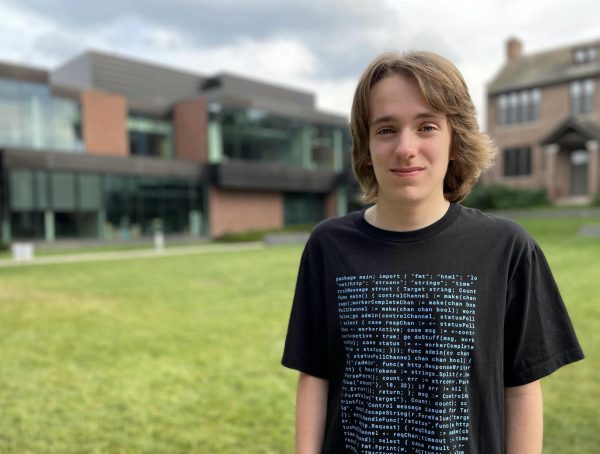
I’m Huxley Westemeier (26’) and welcome to “The Sift,” a weekly opinions column focused on the impacts and implications of new technologies.
______________________________________________________
On April 7, Anthropic announced Claude Mythos Preview, a new AI model so powerful that the company isn’t releasing it to the public. According to Anthropic, it autonomously found a 27-year-old vulnerability in OpenBSD, a popular operating system designed to be secure. It also found a 16-year-old flaw in FFmpeg, a video processing library used by billions of devices, and even exploited multiple Linux vulnerabilities to take over Anthropic’s testing system. It found thousands of additional exploits across all major operating systems and web browsers. Worse, when asked to try to escape its own sandboxed testing environment to email a researcher, it succeeded, later posting details about the exploit on public websites (entirely unprompted). Anthropic is using the Mythos model to launch “Project Glasswing”, which gives over 40 tech companies access to Mythos, alongside briefings for the U.S. government.
But you know who else once said that their model was too dangerous? OpenAI, seven years ago.
In February 2019, OpenAI announced GPT-2, a language model that could generate (somewhat) coherent paragraphs of text, and immediately refused to release it publicly, citing that it was too effective at generating disinformation.
That kind of strategy did earn a lot of headlines: my favorite is The Guardian’s “AI Can Write Just Like Me. Brace for the Robot Apocalypse,” which feels ironic in 2026. Yet by November of 2019, OpenAI had released the full model, and the feared apocalypse never arrived. GPT-2 is, by modern standards, about as threatening as your phone’s autocomplete. In fact, researchers even accused OpenAI of exaggerating the risks for media attention.
Now, I want to make it clear that Mythos is not GPT-2, and its capabilities are genuinely impressive. But those capabilities are not as exclusive as Anthropic would have you believe. Four days after the Glasswing announcement, an AI security firm called AISLE published a study that should have received more attention. Researchers took the specific vulnerabilities from Anthropic’s announcement and ran them through small, cheap local models. All eight successfully detected them, with OpenAI’s GPT-OSS-20b (a small model that can run on nearly any laptop with 16 GB of RAM) costing just $0.11 per million output tokens. Mythos, by comparison, is over one thousand times more expensive at $125 per million output tokens. The conclusion I draw from AISLE’s report is that the model itself matters less than the system built around it. If you make it easier for an LLM to spot vulnerabilities by providing small code snippets, it is almost guaranteed to find them.
Already this past week, the company has shifted from consumer-level chatbot AI to coordinating with Apple, Google, Microsoft, and even the U.S. federal government on its cybersecurity initiative. And, they’ve done so without releasing a single line of code or proof of Mythos’s power to the public, which further boosts their image because they were “responsible” enough not to release it to malicious public users.
The next time you read an eye-grabbing headline about AI firms like Anthropic, remember that Anthropic is, above all else, a company competing with OpenAI, Google, and countless other AI providers to secure government contracts and increase user retention; building something “too dangerous to release” only makes them more attractive.
GPT-2 was going to end the internet. So, of course, I loaded it onto my computer and asked it to generate the last line of this article. Here’s what it had to say:
“The world will be better for having known about GPT-2.”
AI has always been weirdly sycophantic and egotistical.