
Every degree counts: environmental justice when the world is on fire

A legally binding global treaty, known as the Paris Agreement, was adopted in 2015 to combat climate change, aiming to limit global warming to below 2° Celsius. The U.S. joined the treaty under the Obama administration, left under the first Trump administration, rejoined under the Biden administration, and as of Jan. 27, has left again during the second Trump administration.
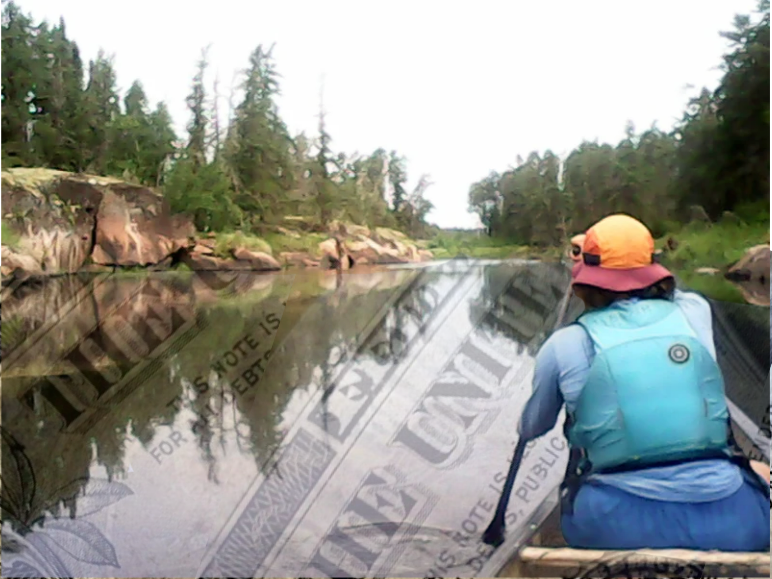
In Minnesota, President Donald Trump’s executive order titled “Immediate Measures to Increase American Mineral Production” allows for the utilization of resources in previously protected areas, which has possible repercussions for the Boundary Waters. Ninth-grader Henry has not personally visited the Boundary Waters, but still has concerns about it. “I would say that [the Boundary Waters] definitely matters. One of the things I love most about America is that there are so many different parts of our country that are just beautiful,” he said.
Environmental policy has shifted significantly during Trump’s second administration, with millions of acres in Alaska opened to oil and gas drilling, the weakening of the Clean Power Plan, alterations to National Environment Policy Act and the Endangered Species Act and the rollback of clean water protections. In the Boundary Waters, mining would irreversibly pollute the land and pose a threat to the wilderness and around 250,000 people who visit it every year.
As a participant in last semester’s environmental science class, junior Ann Li explored the impact of environmental policies through a simulator called En-ROADS. “It is a simulator with many sliders you can move around, such as increased fossil fuel taxes or carbon prices. As you move the sliders, you can see how that would impact the overall rise in temperature,” she said.
NEPA is a broad declaration of national policy to protect the environment. It permanently changed the way the federal bureaucracy operates. This legislation contains disclosure requirements and mandates that federal agencies assess the environmental impacts of their actions before making decisions, rather than after. When passed, NEPA ensured public involvement and promoted informed decisions for protected environments. NEPA gives communities the opportunity to defend against environmental threats, including mining that would likely devastate northern Minnesota’s crucial outdoor recreation economy.
While the simulator is one resource for seeing the effects of climate change, Li thinks there are other ways to become knowledgeable about environmental conditions.
“We have the resources and the power to speak out and to educate ourselves through either classes like environmental science here, or just the internet, which is more widely available to us,” she said.
Li thinks that other issues are the primary focus in the news right now because environmental justice is a drawn-out process that is harder to observe.
“It is important to remember that while those issues are significant and deserve our attention, so does environmental justice because it does play a big role in our lives, whether we feel it or not,” she said.
Although environmental policy has a long history in the U.S., the entire world is affected by its actions. “It is a very interconnected issue that everyone is experiencing globally, and I think people forget the scale of that,” Li said.
In Minnesota, around 5.6 million acres of public land are managed by the Department of Natural Resources, providing recreational trails and camping areas that contribute immensely to the state’s economy. These lands function due to various environmental protections.
Science teacher Rachel Yost-Dubrow teaches the environmental science elective, and in their last unit, the curriculum gives “people a little bit of hope” about climate change. “We talk about what can be done from like an energy use standpoint, to reduce our impacts of climate change,” she said.
To reverse the effects of global warming, specific goals have been established for the next few years. Yost-Dubrow describes the shift in these degree markers. “We were trying to hit 2° or less. Originally, the goal was 1.5°, and now we, the scientists, have figured out that’s really not feasible. So we’ve adjusted to 2°, which will still have a dramatic impact, but hopefully not catastrophic.” The primary goal of the Paris Agreement is to achieve this through global cooperation.
While environmental policy is changing a lot under this current administration, Yost-Dubrow noted that “even in the U.S., where things might be moving slowly, we are moving slowly in the right direction,” she said.
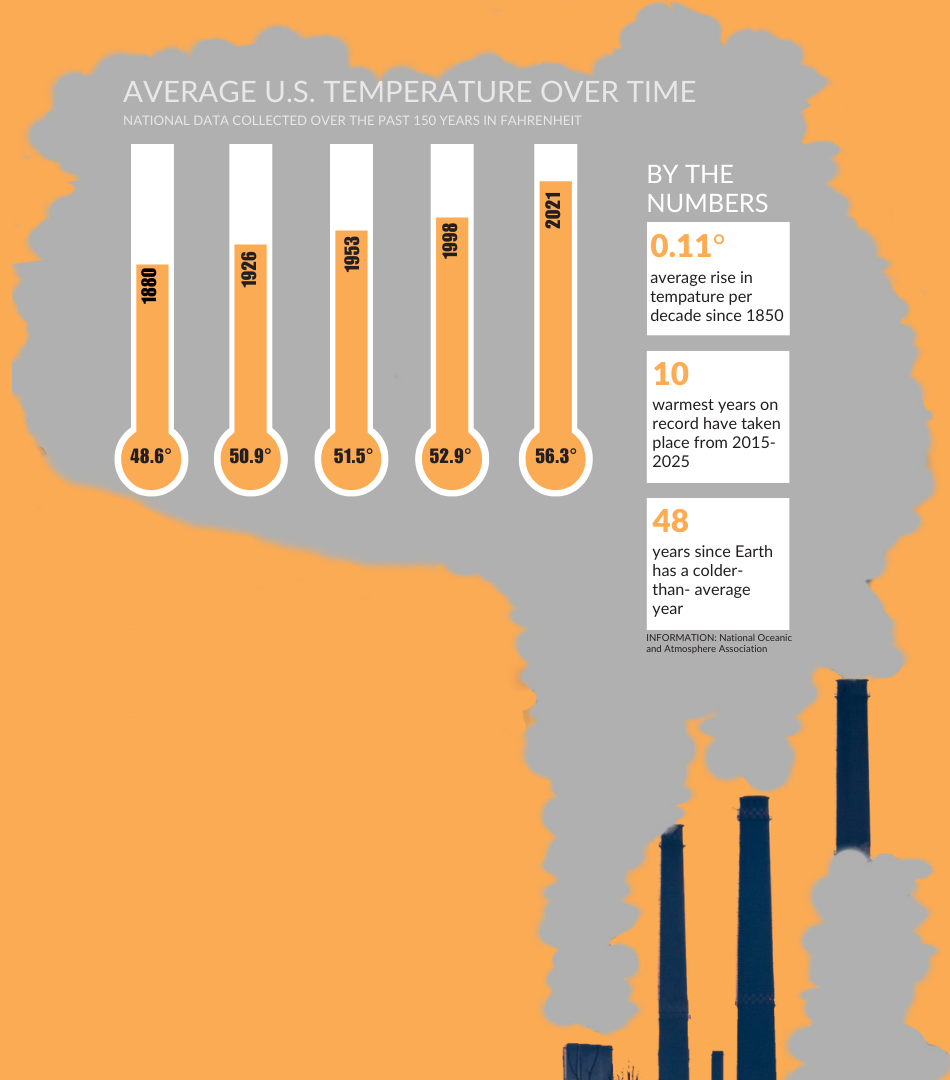

The environment means something different for everyone, but the cause of its damage is the same: human activity. Each year brings growing challenges, from rising emissions and trash-filled oceans to increasingly unpredictable weather patterns. While environmental problems exist on a global scale, the school community continues to value and take action for protection.
For sophomore Noah Miller-Fimpel, the environment can be defined in three sentences. “The environment means the space that I live in,” he said. “That’d be the rivers, the trees and the animals. In school, that’d be my classmates, teachers and the building.” While the environment can be understood in different ways, it generally refers to the place where people live and interact. Despite this, the environment is reaching two critical tipping points: its climate and pollution levels.
According to a December 2024 article by Johan Rockström for WIRED, warming is at an all-time high as society nears a 2.7° increase from pre-industrial levels, with more greenhouse gases emitted into the atmosphere in 2024 than in any previous year. As emissions increase, the Earth nears a climate tipping point, a critical threshold where a small change triggers an often irreversible shift leading to cascading effects on ecosystems, weather and global climate.
To prevent a climate tipping point by reducing emissions, Miller-Fimpel has recognized the issues with conventional vehicles and changed his modes of transportation.
“I think around sixth grade, or fifth grade, I started learning about global warming. My brother biked to school. That’s when I started biking a lot,” Miller-Fimpel said. “I think public transportation, and obviously biking, are great.”
Ninth-grader Zoya Jameel sees another way to prevent climate change through increasing the rate of carbon dioxide absorption.
“I’ve volunteered for planting trees before,” Jameel said. “I feel like I should volunteer more and be more active, because that’s a good thing to do.”
While efforts are being made to reduce carbon dioxide emissions, senior Evy Sachs believes that not enough people are aware of their actions and are still allowing more emissions.
“I do think [being unaware and not carpooling] is happening too often,” Sachs said. “It’s definitely creating a negative impact on our [environment]. It’s … just really amplifying the greenhouse effect, and we’re emitting way too much carbon.” Without a proper solution, the environment’s situation only gets worse.
If the climate tipping point is triggered, the Intergovernmental Panel on Climate Change reports that it would cause a sharp increase in temperatures, especially in the mid-latitude and northern regions of the Earth, unstable precipitation patterns and more severe natural disasters.
The second tipping point is with pollution, mainly concerning recycling and composting. According to WasteDive, in 2025, only 32% of recyclable material was recycled, while CNBC reported that in 2023, only 3.7% of residential food waste was composted.
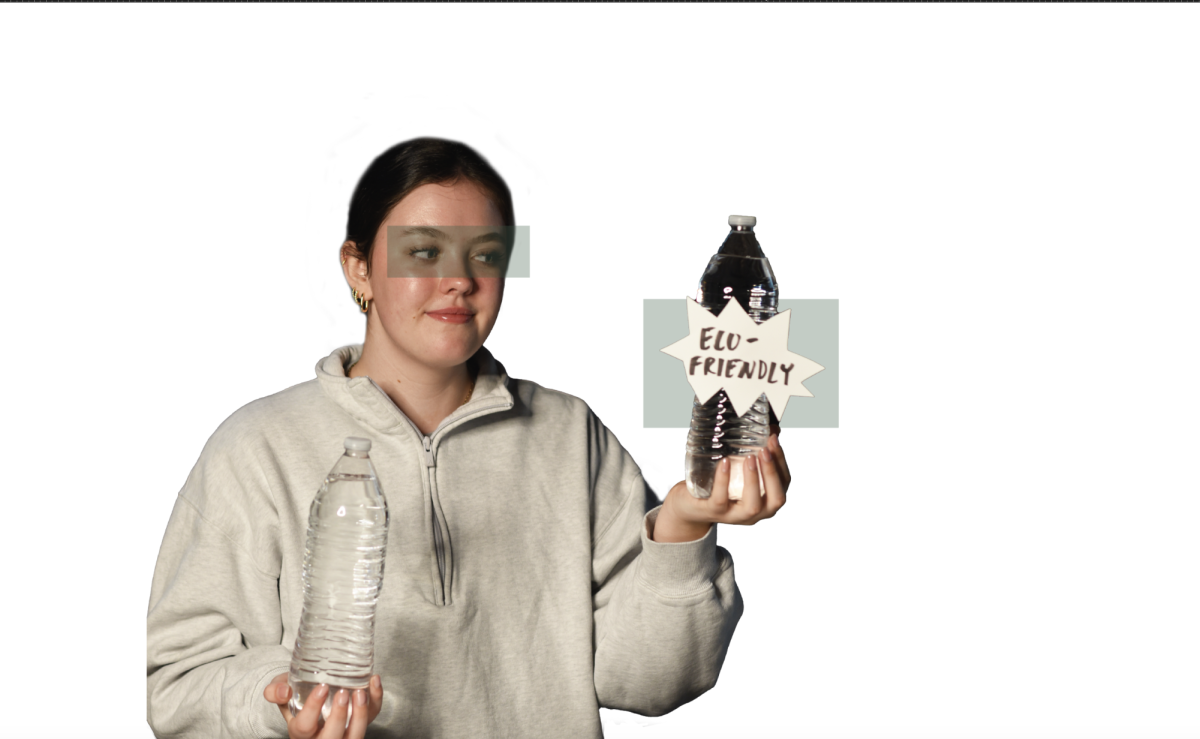
Jameel thinks the main environmentally-friendly action people can take at school is to watch where their waste goes.
“I see so many times where people just put it into any bin, but there are specific things versus specific foods,” Jameel said. “And I feel like that’s honestly the easiest way that people can help, because that’s the biggest thing I’ve seen: compost [and] recycling.”
Recycling and composting both have benefits for the environment. According to the Natural Resources Defense Council and the Environmental Protection Agency, recycling and composting both conserve natural resources, reduce emissions and save energy.
Sachs believes that without recycling and composting, more land and marine life are taken. “An increasing amount of our land is dedicated to just landfills, and then also all the trash that’s going in the sea is really harming ocean life,” Sachs said. “So I feel like people need to be mindful of that and try to reduce the amount of plastic they’re using daily.”
As Miller-Fimpel finds, the distinction between what to recycle, compost and throw away is easily checkable. “I check [to] see if it’s recyclable, but if it comes from something you eat, it’s most likely [compostable],” Miller-Fimpel said.
The environment represents different things for every person, but the issues of climate and pollution threaten to destroy the place where everybody lives. Instead of ignoring the issue and allowing it to get worse, take the time to be mindful of what to recycle and compost, and maybe bike to a friend’s house once in a while. Every action counts.


![CALCULATING THE CHANGES. As study habits have changed, the materials used have changed too. "I remember the day when [my brother] came home with his graphing calculator, [which] had Mario. And I was blown away," Spanish teacher Peter Daniels said. (Photos: Fair Use; Wikimedia Commons)](https://www.rubiconline.com/wp-content/uploads/2026/05/Untitled-design-4-1200x800.png)