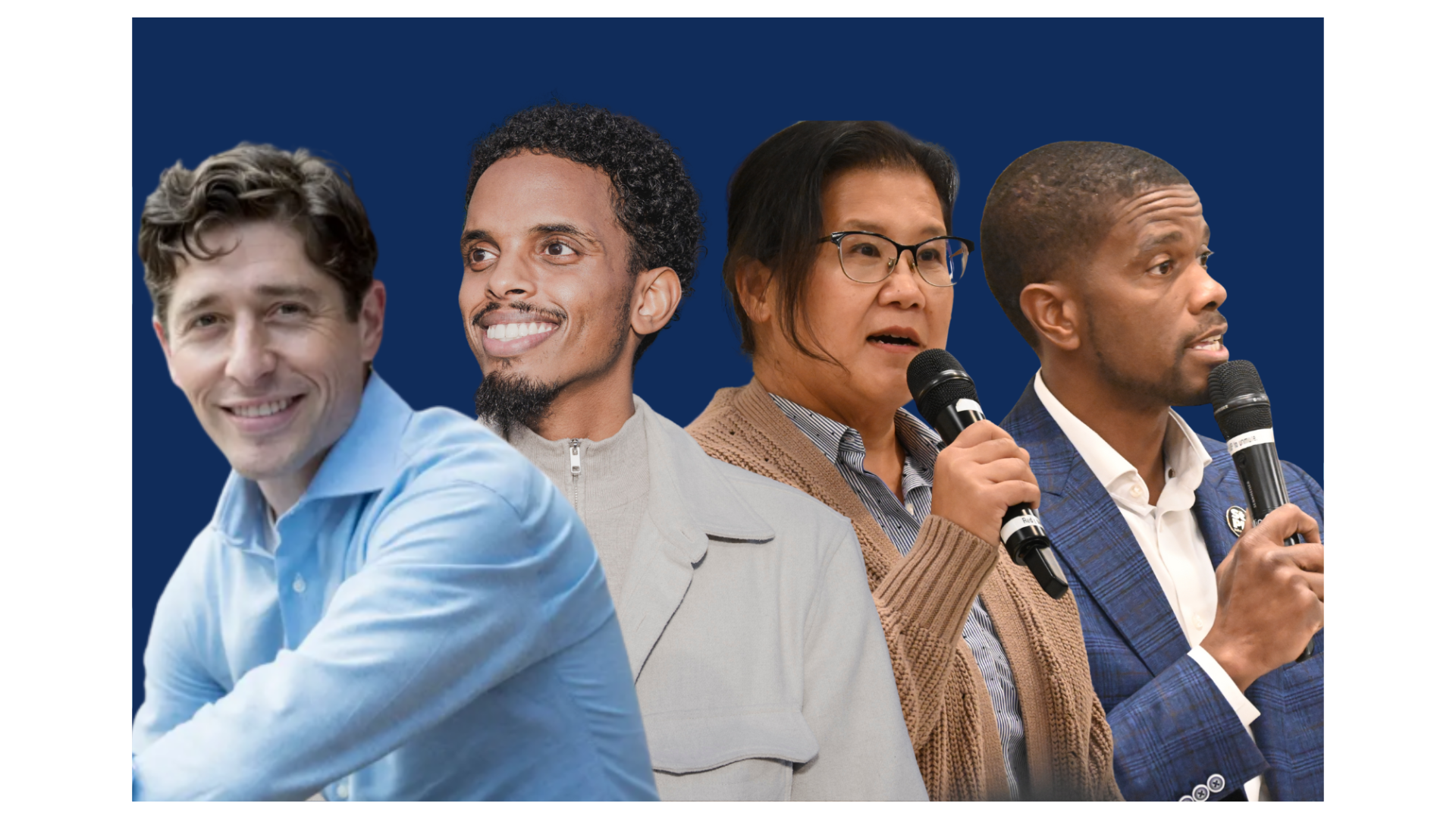


Local mayoral races usually never break into national consciousness, let alone international consciousness. However, when it becomes the question of who will lead America’s largest city, New York City, the stakes become much higher and the world starts paying attention. The 2025 showdown between charismatic Democratic socialist Zohran Mamdani and established figures like incumbent Eric Adams and Andrew Cuomo has dominated political headlines.
A similarly high-stakes race is unfolding right here in Minneapolis–one that mirrors the tension between candidates’ vision and could potentially reshape progressive politics in the Midwest, if not nationally.
On one side, Mayor Jacob Frey, first elected in 2017, is seeking reelection for a third term. On the other hand, there is state Sen. Omar Fateh who represents District 62 (Southwest Minneapolis).
Frey represents the more moderate side of the DFL (Democratic-Farmer-Labor Party), whose agenda will expand affordable housing, create economic opportunities and advance climate action, among other priorities. Fateh rides the wave of democratic socialists gaining prominence, pushing for systemic change in governing, policing and housing.
The similarities between the two cities’ contests go beyond ideology. Both races are playing out in the shadow of massive social upheaval. In New York, rising inequality, housing shortages, and dissatisfaction with policing have fueled Mamdani’s rise. In Minneapolis, the echoes of the George Floyd protests and the ongoing debate around public safety and racial justice still reverberate, even more so after the devastating Annunciation Church shooting. Frey has taken center stage after the shooting, calling for stricter gun laws. Fateh is running on a platform promising transformative change.
Fateh is tapping into deep generational frustrations—particularly among younger voters disillusioned with the wealthy status quo. He insists that Minneapolis must act boldly on climate change, housing, transit and equity. On the other hand, establishment figures like Frey rely on their experience in governance and economic development to gain traction with voters.
In the July convention, Fateh won the Minneapolis DFL mayoral endorsement. This major political upset marked the first time the local DFL had endorsed a challenger over a sitting mayor since 1944. However, in August, the Minnesota DFL revoked Fateh’s endorsement, citing “voting irregularities,” after Frey’s campaign challenged the endorsement, causing Fateh to lose significant party support and resources. The Minneapolis DFL recently appealed the revocation. The controversy reflects the power struggles among different factions of the DFL and a more progressive shift within the party.
Steve Cramer, a former Minneapolis City Council member and CEO of the Minneapolis Downtown Council, has extensive experience leading the effort to revitalize downtown Minneapolis, creating and amending city laws and policies and overseeing city services. According to him, what happens in Minneapolis impacts the entirety of Minnesota and even the Upper Midwest. “It really is the economic center of the region and the state. It is home to five Fortune 500 companies, many professional firms, […] most of the major sports teams, major cultural institutions. A lot of the high-end restaurants that give Minneapolis and the Twin Cities have a national foodie reputation and it generates a tremendous amount of income, income tax, sales tax and other revenues that flow into the state coffers,” Cramer said.
Cramer was frank about his support for Frey’s bid for reelection, saying, “Frey has many, many years now of experience at City Hall [and] has probably a more practical, focused agenda around city issues, particularly public safety, housing affordability, economic development and he has had to wrestle with the budgetary stresses and strains which are becoming more acute, frankly, as federal and state funding for cities begins to wane a little bit,” he said.
In contrast, Senator Fateh has had less overall experience in politics. “He has just been in the state senate, hasn’t really ever run municipal government and doesn’t have the same kind of direct experience that the mayor has accumulated,” he said. Cramer was also put off by the fact that Fateh had previously been part of the defund the police movement. “To be fair to him, he has, since then, changed his views, but I don’t think he would be as strong an advocate of law enforcement as part of an overall system of safety that includes non-policing along with policing strategies integrated into a seamless program, as the mayor has proven himself to be,” he said.
For senior Ella England, inexperience does not matter. Fateh’s youth, transparency and policies, particularly his commitment to raising the minimum wage, rent control and mental health crisis response, appeal to her. “[He seems] coherent and I feel like I could have an actual conversation with him. I think that’s a big thing. People don’t realize how important it is to have politicians that are maybe not necessarily relatable, but [someone you could] sit down and eat lunch with,” England said.
After living in Minneapolis for 16 years, England moved to St. Paul last summer. However, she still interacts with the city frequently and a major issue she has noticed and hopes candidates will address is public safety, particularly diversifying the police department.
England works in North Minneapolis, coaching and tutoring on Mondays. “One Monday, [it was pretty obvious] this person was on some drugs, but they had eight police officers there to deal with it. […] And then the second day, just someone had […] a really bad allergic reaction. They needed to be taken to the hospital. And there were a bunch of police cars there [blocking the parking lots] so parents couldn’t get in to pick up their kids. And I feel like they have better things to do than having police cars block the parking lot to my workplace because someone had an allergic reaction. All you needed was an ambulance there,” England said.
Fateh advocates for diversifying Minneapolis’ public safety response by relying less on armed police and more on non-police responders like mental health professionals. His diversified public safety response initiative focuses on reallocating police resources towards violent crime, because almost half of 911 calls do not require an armed police officer.
These local elections can be viewed as a battleground for the essence of the Democratic Party. Ultimately, this race is not just about city policy; it is about power, vision and the future of urban leadership in a politically divided country.
“I think that the overall […] difference between experience and outlook on the issues is the major, major decision that voters are going to have to make this year between those two main candidates,” Cramer said.
Voting for the Minneapolis mayoral election will occur on Election Day, Nov. 4, 2025. Early mail or in-person voting begins on Sept. 19, 2025 and continues until Nov. 3, 2025.


With election day less than a month away, five candidates are vying to lead Minnesota’s capital city in a race defined by property taxes, public safety, housing and economic growth. This will be the last mayoral race held in an off year, meaning the mayor will serve a three-year term rather than a four-year term. Starting in 2028, St. Paul will synchronize the mayoral election with even-year elections, also when voters elect the governor, state legislators and the president.
Incumbent Mayor Melvin Carter is running for his third term. He faces four challengers including state Rep. Kaohly Her, biophysicist and small business owner Yan Chen, engineer Adam Dullinger and entrepreneur Mike Hilborn. All five candidates are nonpartisan and will use ranked-choice voting, a system St. Paul adopted in 2011.
On public safety, Carter has defended his achievements on crime and city investment that he has made in his last eight years as mayor. He points to declining crime rates and gun violence and his Community-first Public Safety framework, “reducing crime by addressing its root causes,” according to his campaign website. Carter and Her have noted that the fentanyl crisis is a threat to public safety and is something to improve upon.
While Chen, Carter and Her also have plans to support the police department, Hilborn is especially keen on securing more funding and resources for the St. Paul Police Department and increasing the number of police officers.
Following George Floyd’s death, pressure from the federal government to cooperate with Immigration and Customs Enforcement (ICE) and the historical overpolicing of Black and brown communities, repairing the trust between police and communities is also a topic on the table.
“We will never, ever, ever turn our police to go and criminalize people for their identity, because that breaks that trust,” Carter said.
Her agrees. “Because we do have good police officers, we actually have to do a much better job of making sure that our communities know that,” she said.
In addition to conversations around public safety, as deportations rates and ICE raids have become more apparent under Donald Trump’s presidency, immigration is a priority topic. As of 2019, St. Paul is home to more than 60,000 immigrants, making up 19.9 percent of the city’s population. More than half of the immigrant population is Asian, primarily from Laos, Thailand and Burma, most of whom came to the U.S. as refugees.
Her leads with her background as a Hmong refugee, promising that police officers do not cooperate with ICE agents in the city. Carter takes a similar stand, also saying he would not work with ICE. Chen and Dullinger echo similar responses. Hilborn on the other hand, at a forum on Oct. 7, did not provide a definitive answer and showed confusion about the immigration topic.
Affordable housing and development have also emerged as a defining campaign issue. The candidates are in agreement that the city should build more affordable housing quickly, however, solutions vary.
Dullinger, who leads with improving infrastructure and walkability in downtown St. Paul, relied on his engineering expertise, sharing a glimpse into how he would support the construction.
“There’s a lot of discussion about rent control, about how it’s slowing down rental housing, but I think what we really need to be building is housing that people can afford to live in and own,” Dullinger said. “We’re just letting the developers take all those profits, but if we just do the hard work to make it happen, we can use that money and help drive down the prices of the market by putting more housing in.”
Her agrees, saying that the government should financially step in more for housing development and work with smaller development firms.
On the other hand, Hilborn believes more government involvement and regulations on development will hurt affordable housing efforts. He prioritized lowering property taxes as the solution to making the city more affordable to live in.
“The government getting involved in any of this stuff, I’m against all of it. The free market is what’s going to make many things work,” Hilborn said.
Ever since the COVID-19 pandemic began, downtown St. Paul has noticeably been less active. Revitalizing the downtown area has been a priority. Carter points to the efforts in improving infrastructure and developing cultural corridors, highlighting spaces like Little Africa on 678 Snelling Ave. N., St. Paul.
Her has criticized Carter for not doing enough to support cultural corridors and communities in the downtown area, calling out the lack of budgeting for them.
“It is people, organizations, like the Asian Economic Development Association (AEDA) and the African Economic Development Solutions (AEDS) … who have actually invested into these communities,” Her said. “And what these organizations are saying is the city has not shown up to be good partners in the work that’s been done.” Part of her solution to revitalize the downtown area and support cultural communities is to work more closely with community organizations, like AEDA and AEDS.
Chen and Hilborn are focused on the businesses. “If we want to revitalize [downtown] we have to keep people, businesses and residents from leaving,” Hilborn said, circling back to lowering crime rates and taxes. Chen’s approach is to invest more into businesses such as by giving grants.
On brand for Dullinger, he proposes more sidewalks, bike lanes and similar infrastructure to make the city more pedestrian friendly.
“The important thing to do is make the city just a more livable place and to make those spaces places that people actually want to spend time in,” Dullinger said.
While Carter and Her are the biggest names on the ballot in terms of political experience, Chen, Hilborn and Dullinger are making their mark for mayor. With five candidates offering different solutions, from public safety to housing, St. Paul residents will vote on Nov. 4 for their next mayor.
This story was updated on Oct. 25 to add photos to the gallery.


On Wednesday, Nov. 5, shortly after midnight, following Tuesday’s Election Day, Minnesota state Rep. Kaohly Her released an unofficial statement announcing herself as St. Paul mayor-elect.
Later that morning, incumbent Melvin Carter acknowledged defeat, thanking the public for his time in office and congratulating Her.
Although Her was down by about 2% following the first round of ranked-choice voting, receiving fewer first-choice votes than Carter, neither candidate reached the required 50% to achieve victory. However, Her made up substantial ground in the second round, obtaining a clear majority of second-choice votes and securing the St. Paul mayor’s seat for the next three years. She will be both the first woman and first Hmong American to serve as St. Paul mayor.
Earlier in the month, students in the Government and Citizenship social studies elective, available for students in grades 10 through 12, had the opportunity to meet with either Carter or Her in class, depending on their class period.
Her visited senior Jesse Wussler’s class. “She talked about herself and how she was an immigrant and a little bit about her past job experience,” Wussler said. “Then she talked about her policies and what she plans on doing if elected as mayor.”
Her, a Hmong refugee, made clear that city police would not cooperate with U.S. Immigration and Customs Enforcement (ICE) under her mayoral leadership.
Notably, Her’s visit included the chance for a thorough question-and-answer discussion, as students inquired into the details of her policy plans. “People were asking questions about issues that they care about and issues that affect them and trying to see what she would do about it,” Wussler said. “She answered every question. Her points were pretty convincing on what I would vote for. She seemed like she really wanted to be there.”
Carter’s visit followed a similar schedule, discussing in length what he has accomplished as mayor, why he deserves another term and what his future goals would be if reelected.
Senior Otto Rudolf, who was able to attend both visits, found Carter to be slightly more convincing and detailed in his policy plans. “I think Carter was more well-spoken, and he seemed to have a better kind of baseline in terms of issues, probably because he’s been the incumbent for eight years,” Rudolf said. “He was more specific about his plans.”
Interestingly, however, both candidates addressed very similar topics and agreed on many fronts. “They both agree on a lot of the key issues, such as revitalizing downtown St. Paul and preventing crime, especially violent crime and gun-related incidents,” Rudolf said.
An already-established theme of the race, Her outlined a vision for improving the economic prosperity of St. Paul residents, including bringing business and energy back to downtown, which has been somewhat of a ghost town since the COVID-19 pandemic. “She wanted to stop homelessness or try to reduce it a bunch and to make more economic opportunities and incentives for businesses in St. Paul,” Wussler said.
In large part, these policy similarities make sense, given that Her served as Carter’s policy director during his first term. So why did Her choose to run? She was disappointed with the lack of civic engagement and debate surrounding the upcoming election and was uncomfortable with Carter’s seemingly invulnerable security in office over the past couple of years, highlighted by his extremely sparse campaigning in 2025.
“I hadn’t seen door-knockers out sharing ideas and saying what we’d do differently for our city,” Her said. “I thought, ‘Are we really having engagement from people who want to hold that role?’”
Countering Her’s critique of lacking civic engagement under his administration, Carter emphasized the importance of voting, especially for young people. “[Carter] said, if you can go out and vote, I’d appreciate it if you vote for me, but the main thing is, you should just go out there and vote, regardless of for who,” Rudolf said.
Although Rudolf and Wussler are not yet 18, many other seniors voted in the St. Paul or Minneapolis mayoral elections.
In the end, while the race was close and Carter’s continued popularity was again evident, St. Paul voiced its desire for something new by electing Kaohly Her. Her will assume office in January 2026.

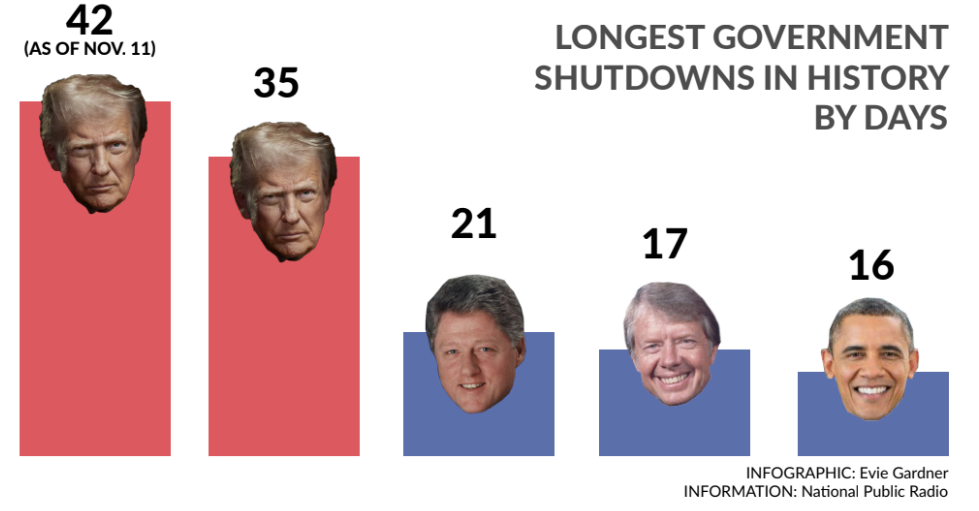
The government is often seen as a stable force to represent the people, but the recent government shutdown has led some students to question its effectiveness. The shutdown is the longest in history, surpassing the previous record of 35 days in 2018-2019.
Many federal employees have either been sent home without pay or are working without pay until the shutdown ends. The delays to college financial aid processing, freezing of research grants and potential closures to programs shed light on how government disagreements impact students’ daily lives.
Senior Salma Blagui has not felt many personal effects of the shutdown, but she is concerned about safety and stability, as air traffic controllers and TSA agents are forced to work without pay. “If someone is in charge of your safety, you want them to willingly be here, or at least be paid for it so you have some kind of guarantee,” she said.
The federal government has been shut down since Oct. 1 due to disagreements in Congress over the federal budget, which included foreign aid revocations and health insurance subsidies in the Affordable Care Act.
With previous knowledge from his Government and Citizenship class, senior Johnny Rog emphasizes the shutdown’s impact on families who rely on food assistance programs. “The only big thing is it can make some things slower, such as food regulations,” he said.
Although Republicans control both chambers of Congress, Democrats in the Senate have negotiated power since Congress needs 60 votes to pass the spending bill. The Republican-led House passed a “clean” continuing resolution, a temporary law that provides funding to government agencies while waiting for appropriations bills to be approved. The bill aimed to keep the government running through Nov. 21. However, disagreements arose over opposition to healthcare cuts, causing a majority of Senate Democrats to vote against the bill. A final vote of 54-46 triggered the government shutdown.
Institutions with government grants won’t face immediate issues, but are unlikely to receive assistance or more funds during a shutdown. With many agency employees furloughed, organizations such as the National Institutes of Health and the National Science Foundation face significant disruption to their research and operations, especially with a reduced staff. “I firsthand discovered, because I’m in astronomy, that we no longer have news on everything, even though we base many of our classes on NASA news,” Blagui said.
International students may also be affected by the shutdown, as the Department of Homeland Security could delay processing applications for status changes. This delay can prevent foreign students from enrolling in classes or renewing legal work visas on time, creating uncertainty about their ability to stay in the U.S. Additionally, organizations such as the Free Application for Federal Student Aid are facing significant delays in application processing, verification and aid disbursement due to a lack of staff. This leads many students unsure how they will pay for tuition or housing.
Ninth-grader Henry Childs recognizes that his knowledge of the subject isn’t very strong, but believes that research is a crucial tool for youth engagement. “I wouldn’t consider myself eligible to have a big voice, but if there was an initiative to educate young people about government more in an accessible way, then a voice could be beneficial,” he said.
The shutdown reveals how the government affects more than just politics; it reaches classrooms, families and the future of millions of American students. While some feel its impact more directly than others, the situation reminds many young people how deeply federal decisions shape daily life. As of press time, the fate of the government is undecided as the shutdown moves into its sixth week. However, a deal to reopen the government was passed by the Senate on Nov. 10, and will be decided by a House vote on Nov. 12.