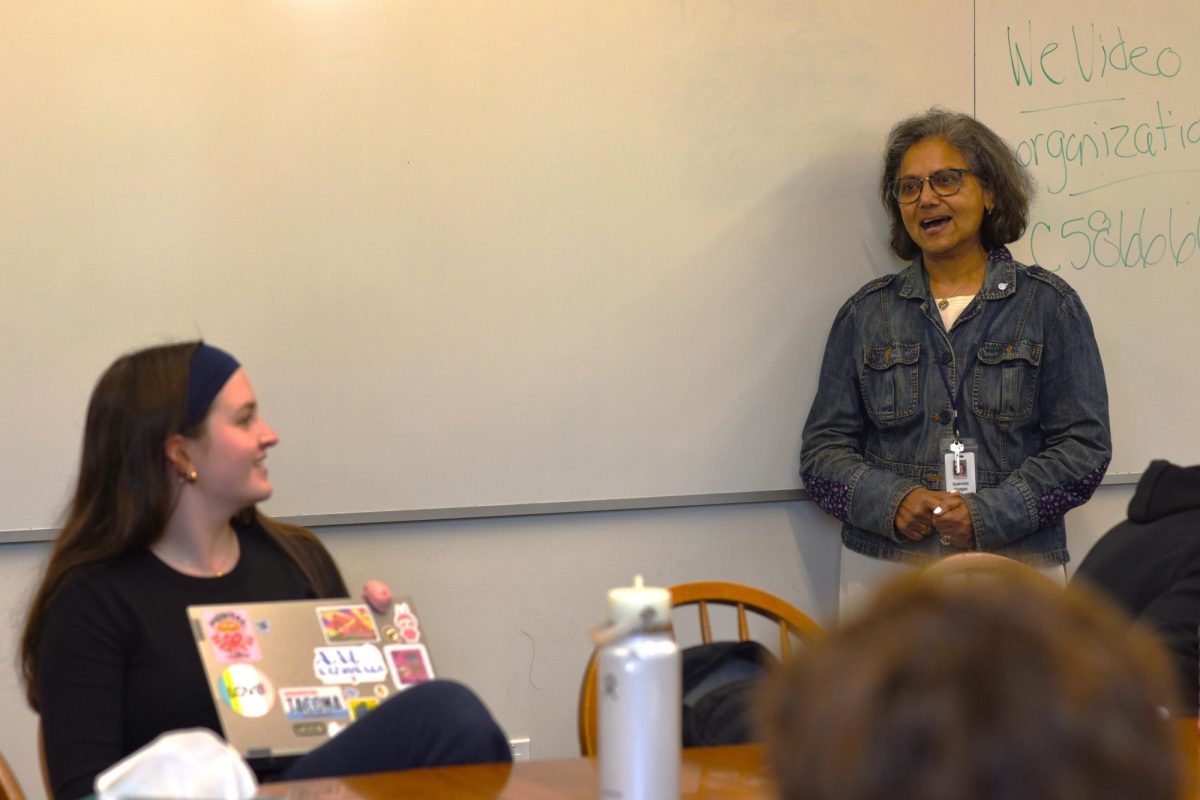


Upper school English teacher Rob van Vliet has a long history with creative writing that dates back to middle school. Despite publishing two poetry chapbooks and one full poetry book called “Vessels,” van Vliet didn’t start out with poetry.
In middle and high school, he believed his writing journey would take the form of writing fiction and songwriting. With those being some of his biggest interests in the field of writing, poetry didn’t take off for van Vliet until early college.
“The thing that ended up being really attractive about poetry was that it’s a short form, so it was fun to be able to build something and then move on,” he said.
The short form allowed him to build a piece and move on, rather than remaining with the same text for an extended period. van Vliet clung to poetry for decades and wrote many poems in the process.
“Weirdly, poetry has stuck because it’s the hardest thing for me to do,” he said.
With a sense of uncertainty and carefully picking at work due to feeling like there’s always something to improve on, writing poetry became a puzzle. Eventually, van Vliet wrote enough poems to realize some of them could fit together into a larger piece of work.
“I was drawn to the poem as a form and then eventually I started thinking, ‘Well, these all kind of go together’,” he said.
van Vliet published his first book two years ago, but the story goes back decades. In the poetry world, it’s normal to send poems out 100 times and only get one acceptance, but for van Vliet, his work eventually got out there: “I’ve been sending out manuscripts for probably 15 years before the book that was published a year and a half ago was accepted,” he said.
His work was accepted by a small press, with editors consisting mostly of volunteers, leading to it taking two years to publish.
“This is stuff that they do alongside their day job, so the timeline can be excruciating,” he said.
Overall, the publication process went smoothly and the editors didn’t make huge changes to van Vliet’s work. Still, once his work left the notebook, it was in someone else’s hands.
“It was a strange process to let go of certain aspects that weren’t mine anymore,” he said. “The work kind of belongs to other people now.”
He expressed gratitude for his publishers: “The two publishers that I’ve worked with were both communicative and supportive.”
During the publishing process, he also experienced some uncertainty around choosing the right poems. He wondered whether he had included his strongest work or whether he accidentally left something out of the book that could have added significance to his work.
In his first poetry workshop in high school, van Vliet heard the person running the workshop say something that stuck with him: “A poem, and this is true for all art, is never finished. It’s just abandoned. I was like, ‘Are you kidding me?’” he said.
Taking this into his future as a writer, van Vliet realized that after an appropriate amount of time, there’s a point where writers have to decide that their work is good enough.
However, even in periods of uncertainty and the journey taking longer than expected, van Vliet held his passion for writing, “I have to see art as something that brings meaning to me and that it’s something that enriches my life and everything else after that is a bonus round,” he said.
“You have to be okay with failure and rejection and disappointment,” he said.
As he has about two or three unpublished books full of poetry, he continues to take poetry at the pace it’s meant to go: “Passion is why we’re here, he said.”
van Vliet’s love for writing makes the commitment overshadow the outcome.
![CALCULATING THE CHANGES. As study habits have changed, the materials used have changed too. "I remember the day when [my brother] came home with his graphing calculator, [which] had Mario. And I was blown away," Spanish teacher Peter Daniels said. (Photos: Fair Use; Wikimedia Commons)](https://www.rubiconline.com/wp-content/uploads/2026/05/Untitled-design-4-1200x800.png)