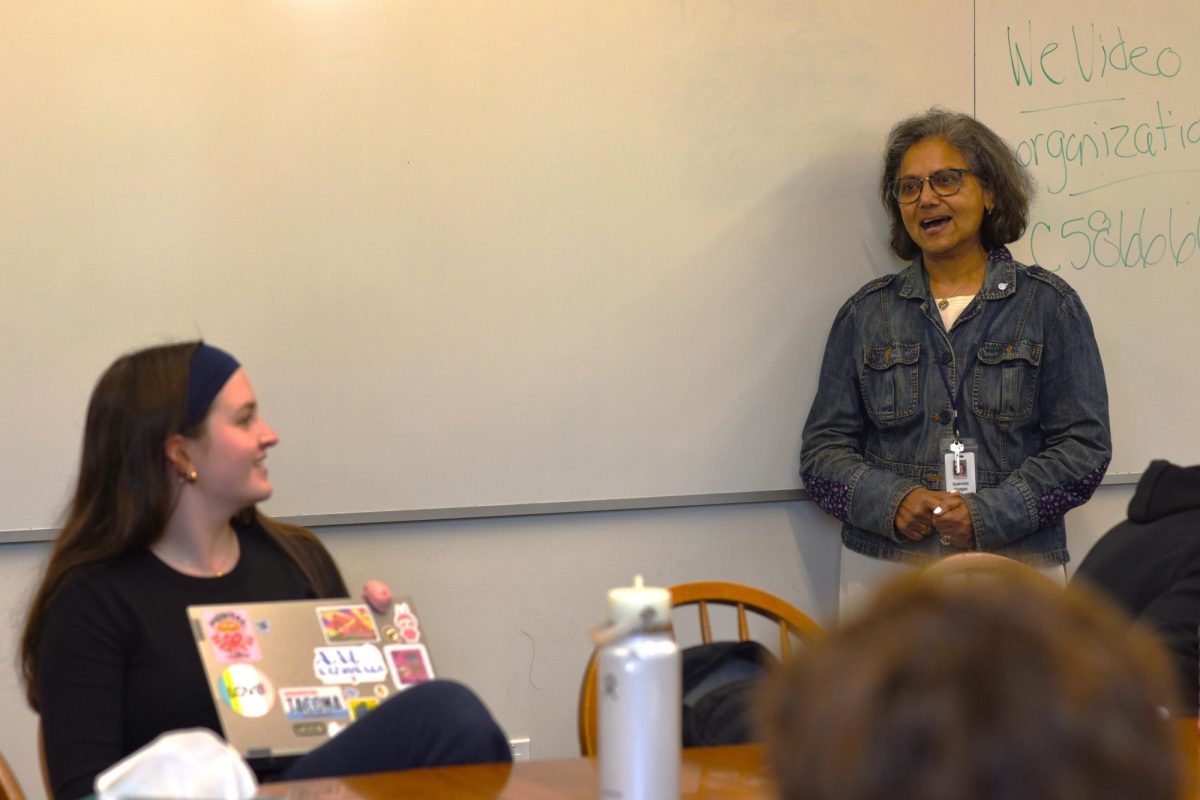


For many students around the world, teaching is seen as just a job. But for most, if not all, teachers at St. Paul Academy and Summit School, teaching in a specific domain is an outlet for passion, rather than just a profession. The result of such passion is visible in the school’s interactive lessons and learning environment, but the real question is, how did our teachers get here?
For upper school science teachers Amy Stading, Kristen Piehl and Stuart Arey, enthusiasm for science and teaching found its way into each of their lives in different ways, but united by one principal factor: interest.
Piehl found a broad fascination with the world when she was younger and narrowed her interest as time went on. “At a very young age, I was just interested in how the world and how things operate and understanding the world around me … and then as I went through school, I learned more about microorganisms, molecular biology and just how the cell worked and how organisms worked on a smaller scale and I found that really interesting,” she said.
Stading was initially surprised by her aptitude for chemistry. “I didn’t think I would like chemistry. When I was a junior in high school, I took our most basic chemistry class and was really good at it. It came very naturally to me. Then, as a senior in high school, I took [a] biochemistry class and AP chem[istry]. I just did some more chemistry, because it came naturally to me and I loved it and studied it in college,” she said.
Arey, too, was interested in science in school and expanded upon his passion through being a scout. “I still remember being young, looking at the sky and trying to do things related to that and how to build shelters. In a sense, that is like science, but it was survival science. That was how I really kind of got interested in [science],” he said.
After science piqued his interest as a child, Arey pursued the subject in college but remained undecided about a career. In fact, the only thing Arey knew he wanted to do was join the Peace Corps, where he eventually found his fervor for teaching. “I wanted to be in the Peace Corps … because I saw ads on television,” he said. “[The Peace Corps told me], you know math and science, we’re going to have you teach.”
Arey was placed in a three-month immersion program to learn French and how to teach pedagogy, the practice of teaching. “It was probably the hardest thing I ever did, but I really wanted to do it, and once I started teaching and working with young people, I was like, I really like this,” he said.
Piehl also found her interest in teaching adolescents through hands-on experiences, which her mentor introduced her to. It was through this that Piehl realized the myriad of career choices available to her. “[My mentor] had us, in some of her pharmacology classes, go into local high schools and teach what we were learning about. I think that kind of planted a seed that [teaching] would be really cool to do. You don’t just have to be a scientist. You can share that information with younger individuals,” she said.
Stading’s passion for teaching emerged earlier in life and was realized through her love of learning. When she reached the collegiate level, she became torn over where to have a career. Stading obtained a doctoral degree to work as a professor, but ultimately prioritized more interactive teaching with younger students over conducting research as a professor. “I realized that at that level, it really is less in the classroom and it’s more about doing research. And I didn’t love that. It was the first time I had kind of gotten to a place and was like, I don’t know if this is exactly the kind of work-life balance I wanted,” she said.
Piehl’s advice for students is to explore the options and opportunities of education. “There are a lot of careers out there that you don’t even know about and so I think the most important thing is to be open-minded and try a bunch of topics and take a lot of classes…Through that, you’ll find that you’re interested in a lot of things and that what you learn in a science class might be really helpful for how you write a policy right for public policy,” she said.
Arey, Piehl and Stading all found their calling for their professions in unique ways, but all settled on their careers by focusing on their happiness. Their enjoyment of their respective domains carries over into the classroom and serves as a reminder to all students to follow their hearts.

![CALCULATING THE CHANGES. As study habits have changed, the materials used have changed too. "I remember the day when [my brother] came home with his graphing calculator, [which] had Mario. And I was blown away," Spanish teacher Peter Daniels said. (Photos: Fair Use; Wikimedia Commons)](https://www.rubiconline.com/wp-content/uploads/2026/05/Untitled-design-4-1200x800.png)